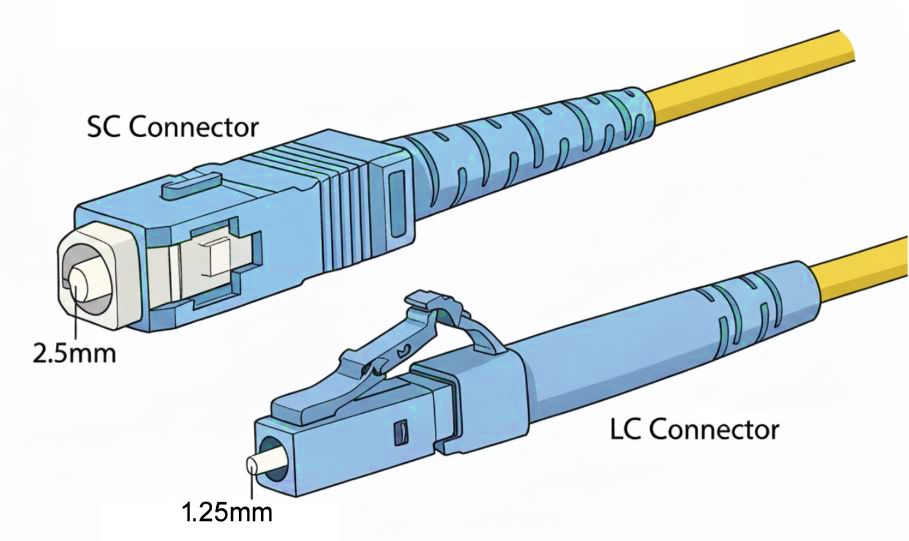

SC vs LC Fiber Fast Connectors: Which One to Choose?
When deploying fiber networks, choosing the right connector impacts performance, cost, and scalability. SC and LC are the two most popular form factors, especially in field-installable fast connector types—which require no epoxy or polishing. Here is a quick guide to their differences and ideal use cases.
What They Have in Common
Tool-less Installation: Both are “fast connectors” with pre-polished ferrules. They are assembled in the field by simply stripping, cleaving, and crimping the fiber.
Solid Performance: High-quality options typically maintain Insertion Loss ≤ 0.35dB, suitable for Gigabit networks.
Shared Markets: Both are widely used in LANs, FTTH, CCTV, and CATV indoor cabling.
SC vs. LC: Key Differences at a Glance
| Feature | SC Connector | LC Connector |
|---|---|---|
| Ferrule Size | 2.5mm (Larger, sturdier) | 1.25mm (Half the size) |
| Latching Mechanism | Push-pull design (simple, robust) | Latch (RJ-45 style, “click” lock) |
| Port Density | Medium (e.g., 24 ports per 1U panel) | High (e.g., 48 ports per 1U panel) |
| Cost | Economical (mass production) | Higher (Precision Materials) |
| Typical Scene | Telecom rooms, FTTH (ONT devices) | Data centers, SFP modules, 40G/100G links |
Choose SC if:
You are working on Telecom or FTTH projects (most optical modems use SC ports).
The environment requires gloved hands or involves outdoor cabinets (larger size is easier to handle).
Budget control is a priority.
Choose LC if:
You are building or upgrading a Data Center with high-density switches.
You use SFP transceivers (LC is the standard interface for SFP).
You need to maximize port counts in limited rack space.
Both connectors are reliable and widely available. In large projects, it is common to use SC for backbone cabling and LC for equipment connections, linked by hybrid patch cords.
Need samples or technical specs? Contact our team for support.